
How to Run a Manassas Park Property Search
The City's Keystone Public Access parcel form is the widest local entry point. It accepts a property address, current owner, parcel ID, deed book and page. It also takes a map/block/pin combination. Each key has tradeoffs. Addresses get typed many ways, and owner names can return several parcels at once. The parcel ID is the tighter key once a match turns up. The Univers assessment form works differently. It starts from parcel ID, map block lot, or street name.
Treat the first result as a lead. Then match the same parcel in the next record set. An owner question calls for comparing the assessor's current owner field against the latest deed. A tax question moves to the Treasurer account. A location question turns to GIS fields and the parcel map. A drawn line is never a legal boundary, though.
- Enter the situs address in the Keystone parcel search and compare the street spelling shown in the result.
- Write down the Parcel ID, Map/Block/Pin, owner field and deed book/page before leaving the parcel screen.
- Carry the deed reference or parcel key into the Prince William Circuit Court land-record index.
- Use Univers for assessment values and the R1 taxpayer portal for bills and account history.
- Open SmartGov or the GIS address service for permit and map context, then ask the custodian for missing records.
The Keystone parcel form lays out the local search keys. Address, owner, and parcel paths all lead to the record for one lot.
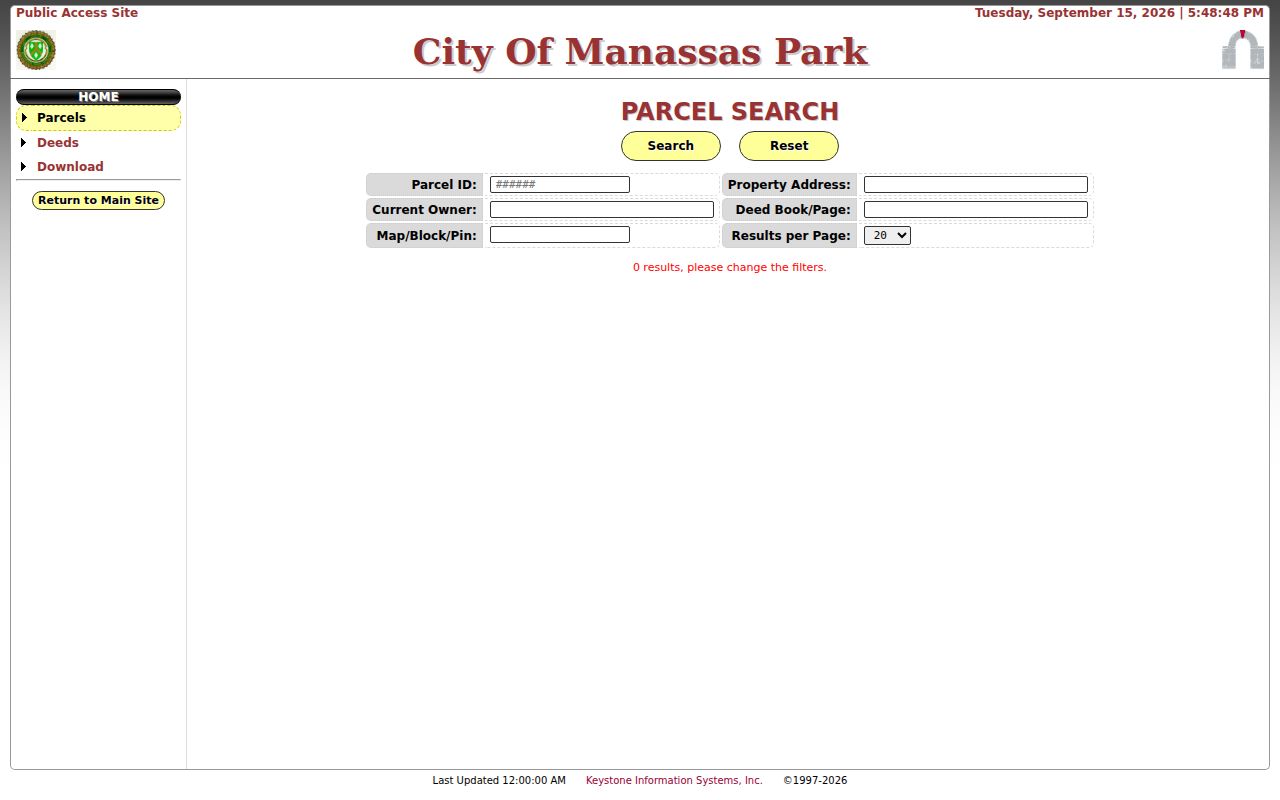
Studying the form helps you pick the right key. Any result still needs comparison against the deed and assessment sources.
Keystone Search Fields for Manassas Park Parcels
Keystone puts several keys on a single parcel search. The form is more than an address box. Current-owner and map-based fields help when the situs line is incomplete. Book/page helps when a deed citation is already in hand. The screen shows a result count plus a selector for how many matches to display. A broad owner search should be narrowed with a map key or address. That step comes before you trust the parcel it returns.
The separate deed-search form uses parcel ID, current owner, and deed book/page. It offers no grantor or grantee fields. The online index start year is not stated. That matters for historical research. Do not assume every party name can be reached through this one form. The same goes for old deeds.
| Visible field | Good starting point | What to confirm |
|---|---|---|
| Property Address | A known Manassas Park situs | Street spelling and parcel ID |
| Current Owner | A likely owner name | Whether the parcel belongs to that person or entity |
| Parcel ID | An exact city parcel reference | Same key in other local systems |
| Deed Book/Page | A recording citation | Latest instrument and legal description |
| Map/Block/Pin | A city map reference | Match on assessment and map views |
Univers Search Uses a Map Block Lot Key
The Univers form exposes parcel ID, map block lot, and street name. Those labels differ from Keystone's combined map/block/pin wording. Copy each value as displayed rather than assuming two formatted keys match. The search is an assessment entry point. Its notice identifies the current display as 2026 values for Fiscal Year 2027. The prior display shows 2025 values for Fiscal Year 2026, effective May 1, 2026.
When a property search aims to compare values, read the current and prior amounts in the same assessment interface. When it aims to confirm a transfer, go back to the deed reference. A current owner label appears on screen. That label does not certify that a very recent closing has reached the tax roll.
Open the Univers assessment database to see its current search choices.
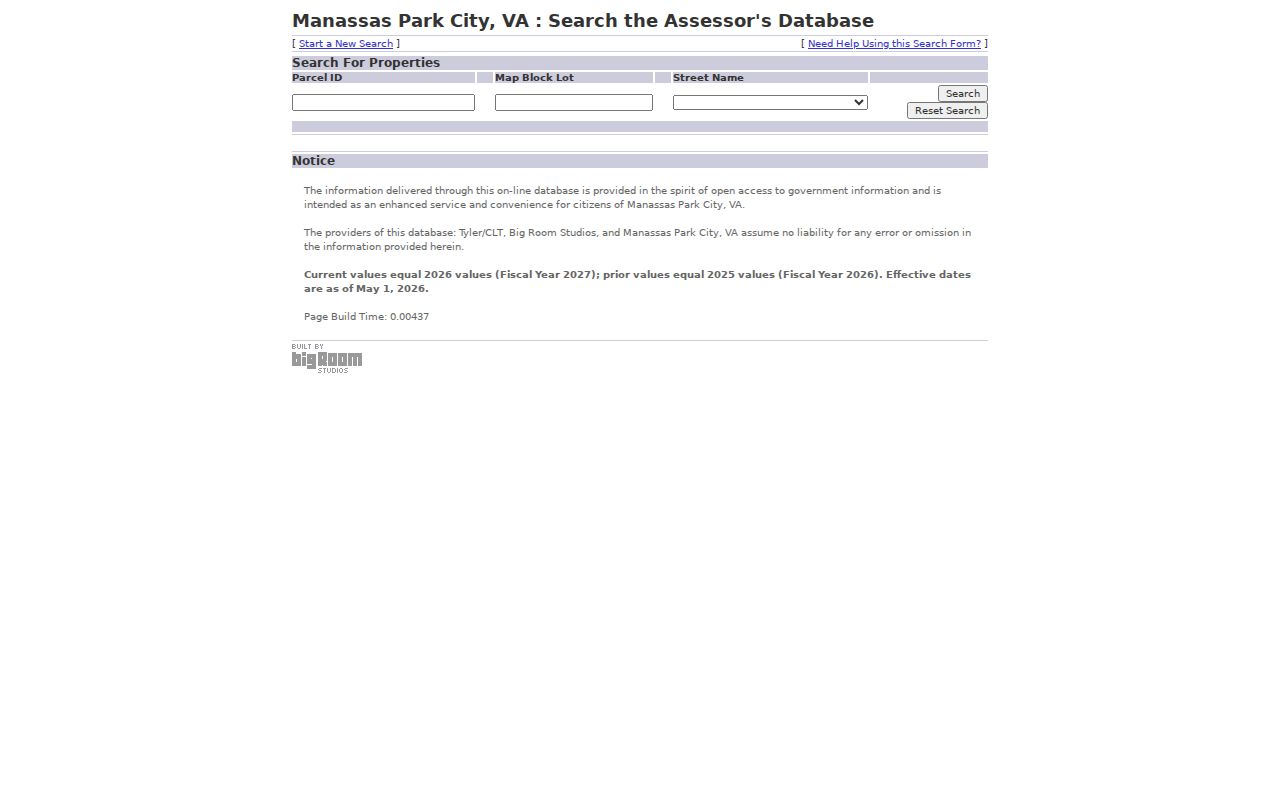
The image shows the separate assessment route; it is not the recorded deed index.
Download Fields Expand a Manassas Park Property Search
The Keystone download page filters by owner, map sheet, acreage, subdivision, and tax code. It then lets you choose output columns. Listed fields include owner address, deed page, sale date, sale price, land value, building value, and total value. Other parcel details also appear. That makes downloads useful for lining records up side by side. Do this after a parcel is identified.
A download is a data extract, not a deed image or a title report. Keep the retrieval date with the file. A subdivision or tax-code list may not be visible. Ask the Assessor rather than guessing at a code. A Subdivision field proves the filter exists. However, the public page does not publish a reliable list of Manassas Park subdivision names.
The Keystone download screen shows its filters and selectable columns.
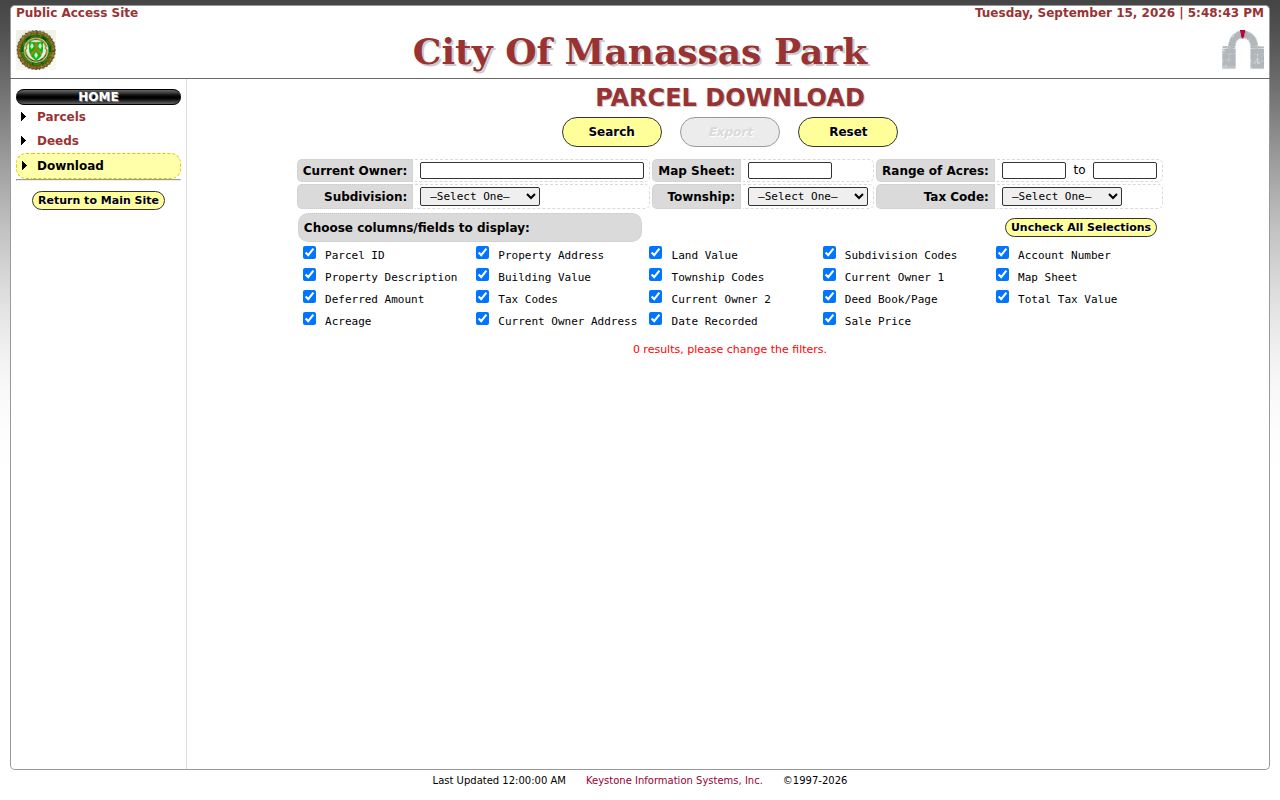
Use the output to organize a parcel comparison, then verify important entries against the source office record.
What a Manassas Park Parcel Result Shows
A Keystone result joins parcel and owner details with a deed reference, while Univers presents an assessment search and its value cycle. Together the screens are strong because each names the property from a different office's viewpoint. The situs address says where the parcel lies. The mailing address says where tax notices go. A deed book/page points to a recorded instrument. Parcel ID and map/block/pin serve as keys for matching the parcel across local systems.
| Current Owner | Name shown in the assessment parcel record |
|---|---|
| Property Address | Situs location, which may differ from the mailing line |
| Parcel ID / Map Key | Local key used to find the same lot in another system |
| Land / Building / Total | Assessment components in the city value record |
| Deed Book/Page | Reference to a recorded instrument, not its full legal opinion |
| Sale Date / Price | Sale fields shown in the parcel download when available |
A parcel result does not prove the named person occupies the property. It does not prove no later deed exists, either. But boundaries drawn on screen are never exact. A current owner field is a helpful lead. A title question calls for the newest recorded instrument and, when needed, professional title work.
SmartGov Helps Find a Manassas Park Parcel
SmartGov's parcel page opens with a public search box that accepts a parcel number, an address, or an owner name. It fills in suggestions as you type. Behind the scenes the page carries fields for street, city, state, and ZIP. It also holds a primary name with begin and end dates. Pick a match and the script passes along the parcel number and address. An owner tag comes through sometimes. That makes the tool a useful fallback when the tax portal rejects an address format.
The map attached to the results draws the 2021 tax-assessment parcel layer. Its identifier field is labeled Parcel_ID. Treat that layer as a snapshot of assessment geography, not as the live deed owner. The map and the recorded instrument sit with different custodians and update on different schedules. Before drawing any ownership conclusion, match the result back to Keystone. You can also check the Clerk's deed index.
Permit searching works much the same way. The public search accepts a permit or parcel number, an address, or an owner name. Once a selection is made, the address fields and primary name populate the application record. Those values describe the chosen result only. They do not prove that every permit category or year is available online. Run the public Search or Advanced search controls. Then open the application record for the specific address and date range you care about.
A blank result is rarely final. Try the Parcel ID or the Map/Block/Pin from Keystone. Check the spelling and the postal label too. The Prince William address layer keeps Inc_Muni separate from Post_Code and Post_Comm. A mailing city or ZIP alone can steer a lookup into the wrong jurisdiction. If alternate keys still fail, ask the office directly. Pick the one that holds the assessment, deed, or permit record.
Choose the Right Manassas Park Property Search Key
An address is the easiest way into a Manassas Park property search. The street must already be known. Owner name works better when a person or entity is familiar. It helps when the location is not. Parcel ID is the strongest tie between records once a match exists. Each key has limits. Streets get abbreviated. Common names return many owners. Parcel numbers change format from one portal to the next. Before treating two Manassas Park property records as the same land, confirm the match with a second key.
| Search key | Useful when | Risk to check |
|---|---|---|
| Address | The situs is known | Street spelling, ZIP and municipal edge |
| Owner | A name is known | Same-name people, trust or LLC vesting |
| Parcel ID | A result has already been matched | Different display formats between portals |
- Situs address
- The physical location of the land or building.
- Mailing address
- The address used for notices; it can be outside the city.
- Parcel ID
- A local identifier that links a tax parcel to related records.
- Owner of record
- The party named in the public parcel or deed record, subject to later filings.
Search Manassas Park by Address, Owner or Parcel
Keystone handles all three search routes. A solid match still needs a second look, though. Compare the situs address with the GIS address point, then match the parcel key in Univers and the deed book and page in the Clerk's index. Postal city names can mislead. A Manassas mailing address does not by itself place a property inside the independent City of Manassas or in Prince William County. For a close case, the Prince William address service shows the Inc_Muni and County fields directly.
| Search Key | Best For | Where It Works | Watch Out |
|---|---|---|---|
| Address | A known property location | Keystone, Univers, SmartGov | Check city, ZIP and street spelling |
| Owner name | A person or entity is known | Keystone; SmartGov autocomplete | Confirm same-name and entity records |
| Parcel ID | A prior result has been matched | Keystone, Univers and SmartGov | Compare the exact local format |
Not a title search. A Manassas Park property search returns public record leads, not a guarantee that title is clear or that an unrecorded interest does not exist. Confirm the newest deed and use a title professional for a title determination.
Similar names come up often in the parcel portal. Compare the situs address and the Map, Block and Pin before choosing a result. The separate deed form searches differently. It accepts Parcel ID, Current Owner, or Deed Book and Page, with no grantor or grantee field. The online start year is not published. An older transfer missing from a screen is a reason to ask the Clerk about the land books, not proof that no deed was recorded.
Keystone's Parcel ID differs from R1's eight-digit account number. The parcel key links assessment and deed records. The taxpayer account, by contrast, routes bill payment, account history, and e-billing. When a search shifts from identifying a lot to checking a balance, move to the Treasurer portal and match the bill year and account there. Assessed value is not the amount due.