
Find Who Owns a Manassas Park Property
With a street address in hand, run the Keystone parcel search. Read the Current Owner field. Note the Parcel ID, Property Address, Map/Block/Pin and Deed Book/Page beside the name. Then carry that deed reference into the Prince William Circuit Court land-record index. Pull the latest recorded instrument. Going from address to assessor to deed is far more dependable than trusting one result as final.
Working from just a name? Search it in Keystone and compare each address and parcel the system returns. One person can own several lots, and a trust or company may hold title. If the parcel card and the deed disagree, compare recording dates. Ask the custodian whether a later instrument is indexed.
- Search the situs address or owner name in Keystone and select the matching parcel.
- Record the Current Owner field, Parcel ID and Deed Book/Page.
- Check the newest recorded instrument in the Prince William Circuit Court land records.
- If the grantee is an LLC or corporation, search that entity in the Virginia SCC system.
- Keep the mailing address separate from the situs; it is a tax-notice address, not proof of occupancy.
The local Keystone parcel search shows its owner and deed-reference fields.
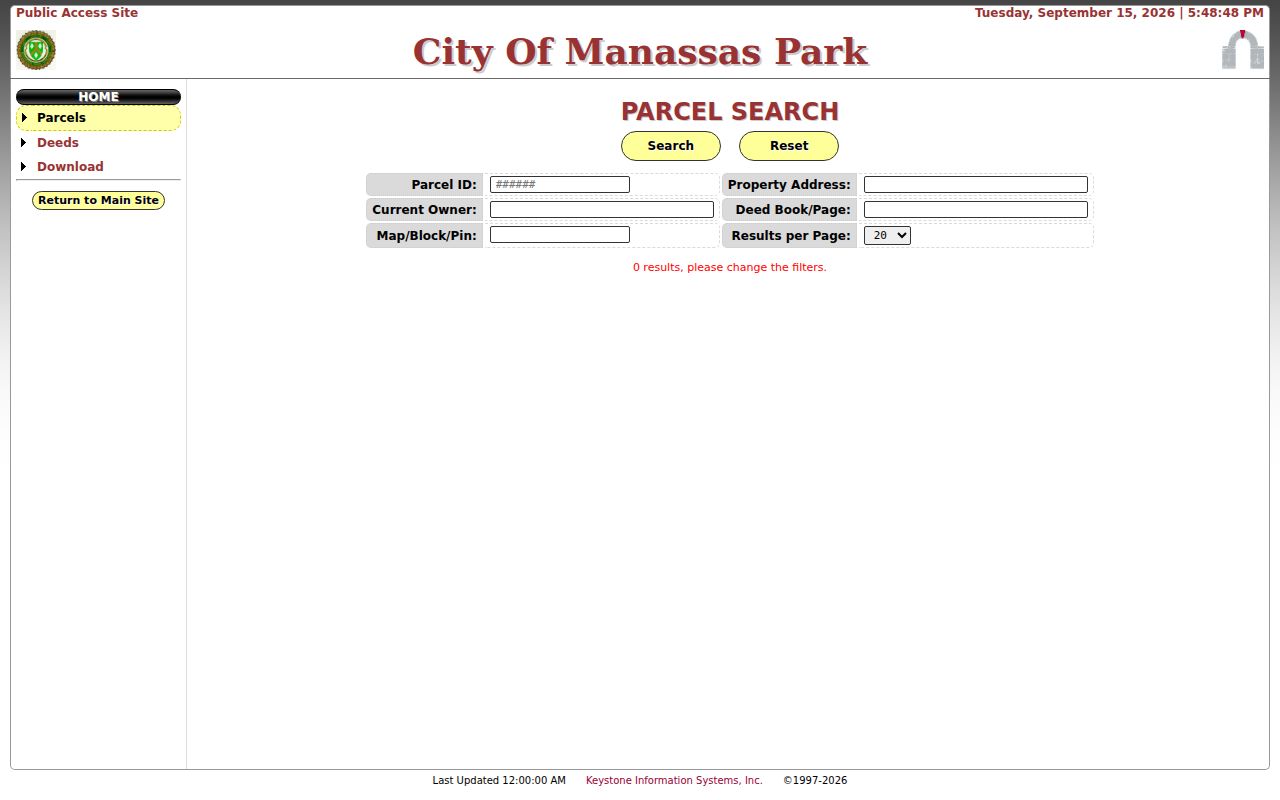
The form gathers the owner, address and parcel keys in one place, which makes it a clean first step for an ownership check.
Keystone Names the Manassas Park Current Owner
Keystone keeps Current Owner, Current Owner Address and Property Address in separate fields. That labeling matters. It stops readers from confusing the owner with the occupant. It also keeps a tax mailing line from being read as the situs. The parcel record also carries Deed Book/Page and Map/Block/Pin. That ties the name to a specific parcel and instrument citation.
Treat the portal itself as a convenience tool rather than a decision-making record. The owner field points you toward the right deed. Read that deed's parties, date and land description to confirm. The field is a lead, not a title guarantee.
Separate Manassas Park Situs and Mailing Addresses
The Property Address marks where the parcel sits. Current Owner Address is simply where mail for the owner record goes. It might be another home, a business office or a mortgage servicer. That split is routine and says nothing about who occupies the building. A postal city label also fails to decide which local assessor applies.
Prince William's address-point fields include Inc_Muni, County, Post_Code, Post_Code4 and Post_Comm. When a Manassas mailing line appears near a boundary, check the municipal and county fields. For any property contact, use the public mailing address for a property-related purpose. Also respect address-confidentiality protections.
Sources Behind a Manassas Park Property Owner Search
Three systems each answer a different part of the ownership question. Keystone and Univers identify the current assessment record. The Prince William Circuit Court Clerk holds recorded deeds and other land instruments. The GIS map helps pin down the parcel and address. Virginia SCC's Clerk's Information System can add public entity details. It is useful when a company appears as grantee. Use them side by side, never one in place of another.
| Source | Owner Info It Gives | Access |
|---|---|---|
| Keystone / Univers | Current Owner, address, parcel and assessment fields | Public parcel search |
| Prince William deed index | Recorded grantee, grantor and instrument reference where available | Index access; images may be gated |
| Virginia SCC CIS | Business-entity filing and public entity details | Official entity search |
| SmartGov map | Parcel location and Parcel_ID context | Public map and autocomplete |
The owner of record is the person or entity named in a public record. An occupant is simply whoever is physically at the property. Public parcel systems are not occupancy directories. A mailing address shows where tax notices go. But it is not a household roster or proof of residence.
Confirm a Manassas Park Owner in the Latest Deed
Start with the parcel card's Deed Book/Page or Parcel ID. That locates the recorded instrument. Read its grantee, grantor, recording date and legal description. The deed may simply be the newer ownership evidence. This can happen if the deed predates the roll's last-sale entry. A search by Current Owner is not a grantor-grantee search. Keystone's separate deed form lists Parcel ID, Current Owner and Deed Book/Page. The form publishes no party-role field.
For index and image availability, use the statewide SRA/COVERS service or contact the Clerk. The SRA information page says index-only access may be free where enabled. Images require a clerk-authorized subscription and payment. The online start year for Manassas Park deed entries is not published.
The Circuit Court land-records office serves several localities. Say the property is in Manassas Park City when asking staff to locate a filing. A Parcel ID, Map/Block/Pin, deed book/page, approximate date and exact party name all help. They separate a matching instrument from another place. They also separate it from a similar name. An index citation is only a locator. The recorded image holds the deed's vesting language and legal description.
The Virginia SRA/COVERS page explains the index and image access model.
Virginia SCC Helps Identify a Company Owner
Some Manassas Park parcels list a company rather than a person as the owner of record. The Virginia SCC Clerk's Information System is the official place to look. Its business search returns entity filings and registered-agent details. A registered agent receives legal notices for the company. That role alone does not reveal who controls the business or benefits from it.
Search the exact entity name printed on the deed. Match punctuation and entity type too. Then read the SCC filing itself for the details that matter. A trust follows a different path through deed records, and the SCC has no record for every trust, so treat the entity search as context rather than proof. The recorded conveyance still governs.
Use the Virginia SCC Clerk's Information System for an entity-name check.
Use the SCC only when a deed names a company. It cannot unpack every private ownership arrangement behind a Manassas Park holding.
A Manassas Park Owner Record Can Lag a Closing
No fixed lag separates a recorded closing from an owner-roll update in Manassas Park. The City portal shows values and a public owner field. It publishes no set refresh schedule. For a recent sale, line up the newest recorded deed against the parcel card's deed citation. Compare the sale date too. Only then judge the roll.
The recording date and book/page put events in order. If a deed is unindexed, ask the Clerk how to confirm the filing. The same goes if its image sits behind a paywall. One system can update while another lags. That timing gap explains most mismatches without pointing the parcel to a different jurisdiction.
Manassas Park Maps Identify Land, Not the Owner
The Prince William Manassas Park ArcGIS service carries address points and jurisdiction fields. It has no owner parcel layer. SmartGov fills that gap with a parcel map and search by parcel, address, or owner name. Find the parcel there and note its key. Verify the owner in assessment data and the deed.
A map line proves where land sits, not who holds title. It cannot show who is inside a building either. When a municipal edge looks unclear, check the Inc_Muni and County fields and take the question to the custodian holding that Manassas Park parcel record.
Limits of a Manassas Park Owner Lookup
A public owner field has limits in Manassas Park. It will not name every beneficial owner, prove occupancy, or clear a title. The grantee may be a trustee, estate, or entity. Virginia's address-confidentiality program lets protected participants use a substitute address. Public property records can lag or run thin. Confirm the newest filing with its custodian, and never read private facts into a mailing line.
Lawful use. Use Manassas Park owner information for property research, title preparation and civic purposes. Do not use a name or mailing address to stalk, harass, intimidate or harm anyone.